How to Brew Oolong Tea: Temperature, Time and Types
How oolong differs from green and black tea, official figures for brewed tea, and how to brew light and roasted oolongs in a gaiwan, a mug or cold-brewed.
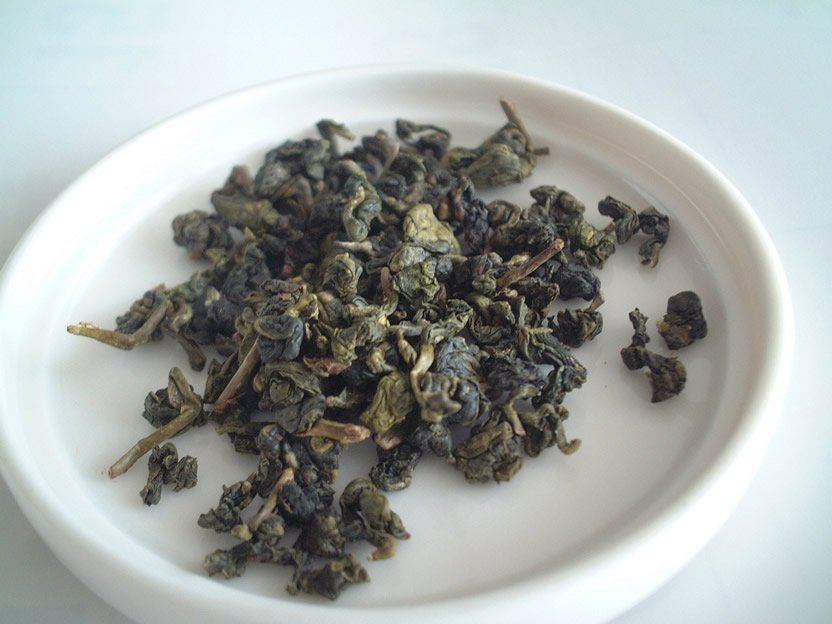

Green, oolong and black tea are made from the same plant, Camellia sinensis. What separates them is not the species but what happens to the leaves after picking, and that is also why oolong confuses people: it covers everything from a pale, flowery Taiwanese high-mountain tea to a dark, toasty roasted one. Brewing them the same way rarely works for both.
This guide explains what "partly oxidized" means, compares brewed teas using official food composition data from Japan and the USDA, and gives brewing methods for each style.
Oxidation: where the maker stops it
Tea people often call this step "fermentation," but it is not microbial fermentation. It is oxidation: enzymes in the leaves react with air once the leaf cells are bruised, darkening the leaf and changing its aroma.
| Tea | Oxidation | Key step |
|---|---|---|
| Green tea | Almost none | Leaves are steamed or pan-fired right after picking, stopping the enzymes |
| Oolong | Partial | Leaves are tossed and bruised so only part oxidizes, then heated to stop it |
| Black tea | Full | Leaves are rolled and allowed to oxidize completely before drying |
How far oolong is oxidized is not fixed; the maker stops it by aroma, so the range is wide. Many oolongs are then roasted over heat, which adds a second dimension to flavor.
Three flavor styles
- Light and floral — light oxidation and little roasting. Pale green-gold liquor and a flowery aroma. Taiwanese high-mountain oolongs and modern-style Tieguanyin belong here
- Roasted — fully roasted, with amber liquor and a toasted-grain aroma. Traditional Tieguanyin and Wuyi rock teas (yancha) are examples
- Heavily oxidized — teas such as Taiwan's Oriental Beauty move closer to black tea, with a honeyed aroma
Brewed teas compared
The first table comes from Japan's official tables, which list several teas brewed under fixed conditions. Leaf amount, temperature and time are set differently for each tea in that source, so the numbers reflect those brewing conditions as well as the leaf.
| Food | Energy (kcal) | Protein (g) | Potassium (mg) | Magnesium (mg) | Folate (µg) | Vitamin C (mg) |
|---|---|---|---|---|---|---|
| Gyokuro (shade-grown green tea) | 5 | 1.3 | 340 | 15 | 150 | 19 |
| Sencha (steamed green tea) | 2 | 0.2 | 27 | 2 | 16 | 6 |
| Pan-fired green tea | 1 | 0.1 | 29 | 1 | 18 | 4 |
| Hojicha (roasted green tea) | 0 | trace | 24 | trace | 13 | trace |
| Oolong tea | 0 | trace | 13 | 1 | 2 | 0 |
| Black tea | 1 | 0.1 | 8 | 1 | 3 | 0 |
Source: MEXT, Standard Tables of Food Composition in Japan (8th rev., 2023 suppl.)
- Every brewed tea is nearly calorie-free. The leaves stay in the pot; only what dissolves ends up in the cup
- Gyokuro stands apart. It is brewed with a large amount of leaf in little water, so its potassium, folate and vitamin C are far above the other rows
- Oolong and black tea show no vitamin C, while sencha and gyokuro do. In these figures, the oxidized teas are the ones without it
- Roasting changes things too. Hojicha is a green tea, yet it shows no vitamin C, like oolong and black tea
A mug of tea, and the water itself
The second table uses USDA data for one 240 g mug, a typical American cup.
| Food | Energy (kcal) | Carbohydrate (g) | Sodium (mg) | Potassium (mg) | Magnesium (mg) |
|---|---|---|---|---|---|
| Oolong tea | 2.4 | 0.36 | 7.2 | 28.8 | 2.4 |
| Green tea | 2.4 | 0 | 2.4 | 19.2 | 2.4 |
| Black tea, brewed with tap water | 2.4 | 0.72 | 7.2 | 88.8 | 7.2 |
| Black tea, brewed with distilled water | 2.4 | 0.72 | 0 | 50.4 | 2.4 |
Source: USDA FoodData Central
The black tea rows show something easy to miss: the water is an ingredient. The same tea brewed with tap water shows more sodium, potassium and magnesium than when brewed with distilled water. Your water's minerals affect both the figures and the taste. Very hard water can make tea look dull and taste flat; very soft or distilled water can taste thin.
Brewing by style
| Style | Water temperature | Notes |
|---|---|---|
| Light and floral | About 195–205°F (90–95°C) | Too hot drives off the floral aroma and adds bitterness |
| Roasted, rock teas | About 205–212°F (95–100°C) | Water just off the boil brings out the toasted aroma |
These are the ranges tea sellers commonly suggest, not fixed rules. Adjust by taste.
In a gaiwan or small teapot, several short infusions
- Warm the pot or gaiwan with hot water and pour it out
- Add a generous amount of leaf, enough to cover the bottom; rolled leaves will expand a lot
- Rinse with hot water for a few seconds and discard it, which helps the leaves start to open
- Steep briefly, starting with well under a minute, and pour out completely
- Repeat, adding a little time with each infusion as the leaves open
In a mug
- Use a teaspoon or two of leaves in an infuser basket that gives them room to open
- Pour water at the temperature for your style
- Steep about 3 to 5 minutes, then remove the leaves so the tea does not keep getting stronger
- The leaves can usually be steeped a second time
Cold brew
- Put leaves in a pitcher with cold water
- Refrigerate for several hours or overnight
- Strain and keep refrigerated; drink within a day or two
Cold brewing gives a smoother, less bitter tea and works especially well with light, floral oolongs.
Hot-brewed iced oolong
Cold brew takes hours. For iced tea in a few minutes, brew strong and pour over ice:
- Use about twice your usual amount of leaf for the volume of hot water
- Steep for your usual time, not longer; extra time adds bitterness rather than strength
- Strain directly into a tall glass packed with ice, which dilutes the tea back to normal strength
- Roasted oolongs hold up especially well this way, keeping their toasty flavor when cold
Fixing a cup that tastes wrong
| Problem | Likely cause | What to change |
|---|---|---|
| Bitter or astringent | Water too hot or steeped too long | Lower the temperature for light oolongs, shorten time |
| Thin and weak | Too little leaf or water too cool | Use more leaf; use hotter water for roasted styles |
| Flat | Stale leaves or very hard water | Try fresh leaves or filtered water |
Bottled oolong vs. brewing your own
Bottled oolong is convenient, but it is a different product from what you brew at home:
- Read the label for sugar. Unsweetened bottled oolong is common in Japanese and Asian groceries, but many American-market tea drinks are sweetened, which the plain-tea tables above do not reflect
- Flavor is standardized. Bottled teas are usually made from a blend for consistency and tend toward the roasted style
- Brewed tea is best fresh. Keep homemade iced or cold-brewed tea in the fridge and finish it within a day or two; it loses aroma and can turn cloudy
Buying and storing oolong
- Rolled vs. twisted leaves: both are normal. Rolled balls (common in Taiwanese oolong) open slowly; long twisted leaves (common in Wuyi teas) open faster
- Look for a harvest or packing date. Light oolongs taste best fresh; roasted ones keep their character longer
- Store airtight, away from light, heat, moisture and strong smells. Tea absorbs odors easily, so keep it away from spices and coffee
- Unopened vacuum packs of light oolong can go in the fridge; let them come to room temperature before opening to avoid condensation
How different countries drink oolong
- United States — Bottled and canned iced oolong, milk teas and bubble tea are the most common encounters, with loose-leaf oolong in specialty tea shops
- Korea — Green tea from Boseong and Jeju is better known; oolong appears mainly as bottled tea and at tea cafés
- Japan — Cold bottled oolong (ūroncha) is a standard convenience-store drink and a common pairing at restaurants and izakaya
- Spanish-speaking countries — Oolong is mostly found in specialty shops and tea houses, usually served hot and plain, while yerba mate and black tea are more traditional in parts of South America
Wherever it is sold, oolong rewards a little attention to style. Brewing a light oolong cooler and a roasted one hotter is the single change that makes the biggest difference.
FAQ
Does oolong tea have caffeine?
Yes. Green, oolong and black tea all come from the same plant and all contain caffeine. The amount in a cup varies with the leaf, how much you use, water temperature and steeping time, so there is no single figure for "oolong." Bottled oolong drinks list caffeine on some labels.
Why can I steep the same oolong leaves several times?
Rolled oolong leaves open slowly, releasing flavor over several short infusions instead of all at once. In a small pot with plenty of leaf, many people get four or more infusions, with the flavor changing from flowery to deeper.
Can I add milk or sugar to oolong?
You can, and Taiwanese milk tea and bubble tea shops often use roasted oolong. Note that milk and sugar add calories and carbohydrate that plain brewed tea, as the tables show, almost does not have.