Nuts and Seeds: Nutrition per Ounce, Salted vs. Unsalted, Storage
Almonds, walnuts, peanuts, pecans and pumpkin, chia and flax seeds compared with USDA data per ounce, plus salted nuts and storage.
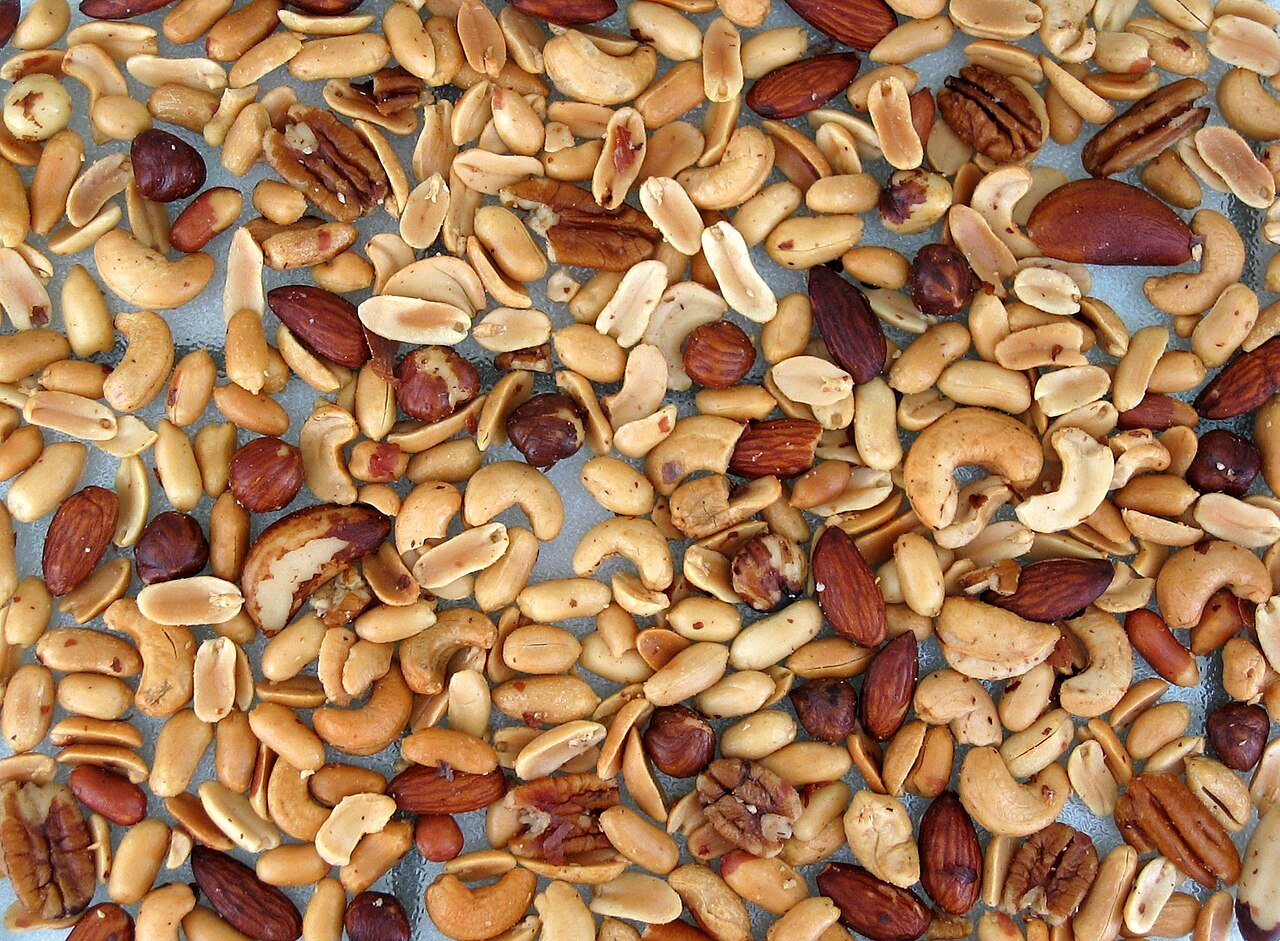

Nuts get recommended as an easy snack, and then the questions start. How much is "a handful"? Is the salted can different from the raw bag? And why did the walnuts in the pantry start tasting like crayons?
This guide answers those with official USDA FoodData Central figures for nine nuts and five seeds, compares them per 100 g and per ounce, shows what salt and honey roasting add, and walks through storage that keeps the oil from going rancid.
Nuts compared, 100 g each
| Food | Energy (kcal) | Protein (g) | Fat (g) | Saturated fat (g) | Carbohydrate (g) | Fiber (g) | Magnesium (mg) | Vitamin E (mg) |
|---|---|---|---|---|---|---|---|---|
| Almonds | 579 | 21.1 | 49.9 | 3.8 | 21.6 | 12.5 | 270 | 25.6 |
| Walnuts, English | 654 | 15.2 | 65.2 | 6.1 | 13.7 | 6.7 | 158 | 0.7 |
| Peanuts | 567 | 25.8 | 49.2 | 6.3 | 16.1 | 8.5 | 168 | 8.3 |
| Cashews | 553 | 18.2 | 43.9 | 7.8 | 30.2 | 3.3 | 292 | 0.9 |
| Pistachios | 560 | 20.2 | 45.3 | 5.9 | 27.2 | 10.6 | 121 | 2.9 |
| Pecans | 691 | 9.2 | 72.0 | 6.2 | 13.9 | 9.6 | 121 | 1.4 |
| Hazelnuts | 628 | 14.9 | 60.8 | 4.5 | 16.7 | 9.7 | 163 | 15.0 |
| Macadamia nuts | 718 | 7.9 | 75.8 | 12.1 | 13.8 | 8.6 | 130 | 0.54 |
| Brazil nuts | 659 | 14.3 | 67.1 | 16.1 | 11.7 | 7.5 | 376 | 5.7 |
Source: USDA FoodData Central
Reading across the rows:
- Every nut is calorie-dense. Even the lowest row is well over 500 kcal per 100 g. Macadamias and pecans sit at the top
- Peanuts lead on protein. Strictly, peanuts are legumes, not tree nuts, which helps explain the difference. Almonds come next
- Saturated fat differs a lot. Brazil nuts and macadamias are the highest; hazelnuts and almonds are among the lowest
- Almonds stand out for vitamin E and fiber, with hazelnuts well up on vitamin E too
- Cashews are the starchiest, with the most carbohydrate, which is part of why they grind into such smooth cashew cream
Seeds compared, 100 g each
| Food | Energy (kcal) | Protein (g) | Fat (g) | Saturated fat (g) | Carbohydrate (g) | Fiber (g) | Magnesium (mg) | Vitamin E (mg) |
|---|---|---|---|---|---|---|---|---|
| Sesame seeds, whole | 573 | 17.7 | 49.7 | 7.0 | 23.4 | 11.8 | 351 | 0.25 |
| Sunflower seed kernels | 584 | 20.8 | 51.5 | 4.5 | 20 | 8.6 | 325 | 35.2 |
| Pumpkin seed kernels (pepitas) | 559 | 30.2 | 49.0 | 8.7 | 10.7 | 6 | 592 | 2.2 |
| Chia seeds | 486 | 16.5 | 30.7 | 3.3 | 42.1 | 34.4 | 335 | 0.5 |
| Flaxseed | 534 | 18.3 | 42.2 | 3.7 | 28.9 | 27.3 | 392 | 0.31 |
Source: USDA FoodData Central
- Pumpkin seed kernels (pepitas) have the most protein and magnesium of any row in either table
- Chia and flaxseed are in a different league for fiber, and they have less fat than the nuts above
- Sunflower seed kernels carry more vitamin E than any nut, almonds included
- Sesame is usually eaten a spoonful at a time, so its 100 g numbers are mostly useful for comparison, not for counting
Per ounce: what a serving actually holds
US nutrition labels usually list nuts per 1 ounce (28 g). Here is the same data at that size.
| Food | Energy (kcal) | Protein (g) | Fat (g) | Fiber (g) |
|---|---|---|---|---|
| Almonds | 162 | 5.9 | 14.0 | 3.5 |
| Walnuts | 183 | 4.3 | 18.3 | 1.9 |
| Peanuts | 159 | 7.2 | 13.8 | 2.4 |
| Pistachios | 157 | 5.6 | 12.7 | 3.0 |
| Pecans | 193 | 2.6 | 20.2 | 2.7 |
| Macadamia nuts | 201 | 2.2 | 21.2 | 2.4 |
| Pumpkin seed kernels | 157 | 8.5 | 13.7 | 1.7 |
| Chia seeds | 136 | 4.6 | 8.6 | 9.6 |
Source: USDA FoodData Central
An ounce of most nuts lands in a fairly narrow calorie band. Macadamias and pecans give the most calories per ounce, while pumpkin seeds give more protein than any nut in the table. The difference between snacking from a measured dish and eating from the bag is usually far larger than the difference between one nut and another.
Weigh once, then use a dish
- Put an empty small bowl on a kitchen scale and zero it
- Add nuts to 28 g (1 ounce)
- Look at how full the bowl is. That is your reference
- Next time, fill the same bowl without the scale
Counting nuts is less reliable, because size varies by variety and grade.
Salted, honey roasted and nut butters: check sodium and sugar
Roasting by itself changes little. What gets added does.
| Food | Energy (kcal) | Fat (g) | Sugars (g) | Sodium (mg) |
|---|---|---|---|---|
| Almonds, dry roasted, no salt | 598 | 52.5 | 4.9 | 3 |
| Almonds, dry roasted, salted | 598 | 52.5 | 4.9 | 234 |
| Almonds, honey roasted | 594 | 49.9 | — | 130 |
| Peanuts, dry roasted, no salt | 587 | 49.7 | 4.9 | 6 |
| Peanuts, dry roasted, salted | 587 | 49.7 | 4.9 | 410 |
| Pistachios, dry roasted, no salt | 572 | 45.8 | 7.7 | 6 |
| Pistachios, dry roasted, salted | 569 | 45.8 | 7.7 | 428 |
| Cashews, dry roasted, salted | 574 | 46.4 | 5.0 | 640 |
| Mixed nuts with peanuts, dry roasted, salted | 594 | 51.5 | 4.8 | 345 |
| Peanut butter, smooth, no salt | 598 | 51.4 | 10.5 | 17 |
| Peanut butter, smooth, salted | 598 | 51.4 | 10.5 | 426 |
Source: USDA FoodData Central · — = not measured
- Salt is the big change. Dry-roasted almonds, peanuts and pistachios without salt have almost no sodium; the salted versions have far more. Salted cashews are the highest row
- Honey roasted almonds carry sodium as well. The USDA entry has no sugar measurement, so check the "Added sugars" line on the package label
- Peanut butter follows the same pattern. Look for "no salt added" or check the sodium line on the Nutrition Facts label
- Calories barely move between salted and unsalted versions
Sodium matters in context. The World Health Organization recommends adults keep salt under 5 g a day, which is less than 2,000 mg of sodium. A salted snack mix eaten alongside a sandwich and a bowl of soup adds up quickly. If you like the salt, an easy middle path is to mix unsalted and salted nuts half and half.
How to buy nuts and seeds
- Packaging date — Fresher is better. Nuts sit on shelves a long time, so look for a date and pick the latest
- Smell and look — Bulk bins should smell nutty, not sharp or painty. Kernels should look plump, without dark spots or shriveling
- In the shell or shelled — Shells protect the kernel, so in-shell nuts keep longer. Shelled and chopped nuts go stale fastest because more surface touches air
- Ingredient list — For plain nuts, it should name only the nut. "Roasted in oil," salt, sugar, honey or seasonings are additions
Storage: keep out light, heat and air
The fat in nuts breaks down over time and turns rancid. Light, heat and air speed that up, so the goal is to block all three.
- Move opened bags to an airtight container or a zip-top bag with the air pressed out
- Keep a week's worth in the pantry and the rest in the refrigerator
- For anything you will not use within a month or so, freeze it. Nuts freeze well and can be used straight from the freezer for baking and cooking
- Store away from strong odors in the fridge. Nuts pick up smells from onions and leftovers
- Taste before using in a recipe. One rancid walnut can spoil a whole batch of banana bread
Walnuts, pecans, pine nuts and ground flaxseed go off fastest. Whole flaxseed and almonds keep comparatively well.
Toasting at home
- Spread nuts in a single layer on a sheet pan
- Bake at 350°F (about 175°C) for roughly 5 to 10 minutes, depending on size, stirring once
- Pull them as soon as they smell toasty and look a shade darker; they keep cooking on the hot pan
- Cool completely before storing, or condensation will make them soft
Small seeds such as sesame and pepitas toast faster in a dry skillet over medium heat. Keep them moving and stay close; they go from golden to burnt quickly.
How different countries eat nuts and seeds
- United States — Peanut butter is a pantry staple, and trail mix, almond milk, pecan pie and walnut-studded brownies keep nuts in everyday eating. Roasted salted nuts are a classic bar and game-day snack
- Korea — Small packs of mixed nuts sold as a daily portion are popular, and toasted sesame seeds and pine nuts finish many dishes. On the first full moon of the lunar year, people crack walnuts and peanuts in a custom called bureom
- Japan — Ground sesame is a seasoning in its own right, as in goma-ae (vegetables dressed with sesame). Roasted almonds with small dried fish are a classic snack
- Spanish-speaking countries — Mexico uses pepitas and peanuts in sauces such as pipián and some moles, and roasted pumpkin seeds are a street snack. In Spain, Marcona almonds and toasted almonds in turrón are traditional
None of these is the single right way. If you mostly snack on nuts from the bag, the most useful change is measuring a portion once; if you cook with them, freezer storage does the most to keep them tasting good.
FAQ
How much is a handful of nuts?
Hands vary too much to say. Weigh once on a kitchen scale; nutrition labels on US packages usually use 1 ounce (28 g) as the serving. Put that amount in a small dish so you can see what it looks like, then use the same dish afterward.
Are roasted nuts less nutritious than raw?
In the USDA data, dry-roasted almonds, peanuts and pistachios are close to the raw versions in calories and fat. The bigger difference is what gets added during roasting, mainly salt, oil or sugar. Check the ingredient list for anything besides the nut itself.
Why do my walnuts taste bitter or smell like paint?
That is rancid oil. Nuts and seeds are rich in fat, and light, heat and air break it down. Walnuts and pecans turn faster than most. Rancid nuts are unpleasant to eat; throw them out, and keep the next bag in the fridge or freezer.
Do chia seeds and flaxseed need to be soaked or ground?
Chia seeds can be eaten dry, but most people soak them in liquid, where they form a gel, as in chia pudding. Whole flaxseed is hard and tends to pass through intact, so it is usually bought or ground into flaxseed meal before use.